Specifications
Surface Treatments
Certifications
- ISO 9001 - 2015 Certified
- PED 2014/68/EC
- NACE MR0175/ISO 15156-2
- NORSOK M-650
- DFAR
- MERKBLATT AD 2000 W2/W7/W10

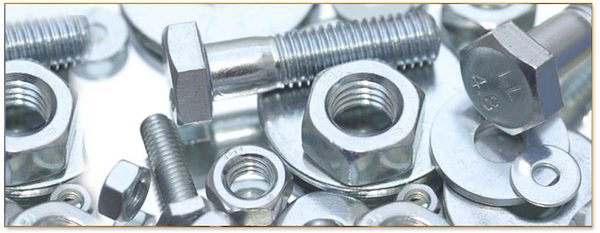
Hiduron hex nuts are matched-grade Cu-Ni-Al nuts forged to DIN 934 and ISO 4032 standard hex pattern for European procurement, plus ASME B18.2.2 hex pattern for US procurement. Standard size range is M12 through M64 metric and 1/2 inch through 2-1/2 inch Unified UN, UNC and UNF. Nuts are forged from solution-annealed Hiduron bar with grain flow through the wrench flats, then age-treated to the same gamma-prime envelope as the matched studs and bolts. Hiduron nuts are supplied from the same heat lot as the matched stud or bolt to keep chemistry traceability single-source on the mill test certificate. Primary applications: matched-grade nut for every Hiduron stud bolt, hex bolt and heavy hex bolt in subsea, marine, naval and NACE MR0175 sour-service bolting. Pairing a Hiduron stud with a steel or stainless nut creates a galvanic cell in the clamped joint and is rejected by naval and sour-service procurement.
The Hiduron family chemistry is a small Cu-Ni-Al window with manganese as the principal differentiator between Hiduron 130 and Hiduron 191. The Cu balance plus the controlled Ni, Al and Fe land the gamma-prime Ni3Al precipitation response on solution-anneal plus age. Hiduron 191 carries the higher manganese addition for solid-solution strengthening on top of the gamma-prime precipitation, which lifts the room-temperature yield and tensile envelope above the Hiduron 130 baseline.
| Element | Hiduron 130 typical, percent | Hiduron 191 typical, percent | Role |
|---|---|---|---|
| Copper (Cu) | balance (~80 to 82) | balance (~76 to 78) | Matrix; seawater corrosion resistance |
| Nickel (Ni) | 14.0 to 15.5 | 14.0 to 15.5 | Strengthening partner for gamma-prime Ni3Al |
| Aluminium (Al) | 2.7 to 3.4 | 1.5 to 2.5 | Gamma-prime former; precipitation hardening |
| Iron (Fe) | 1.0 to 2.0 | 0.5 to 1.5 | Grain refinement; corrosion modifier |
| Manganese (Mn) | up to 0.75 | 4.0 to 5.0 | Solid-solution strengthening (191) |
| Silicon (Si) | up to 0.10 | up to 0.10 | Deoxidation residual |
| Lead (Pb) | up to 0.02 | up to 0.02 | Tramp limit for hot workability |
| Carbon (C) | up to 0.05 | up to 0.05 | Tramp limit |
Both grades develop their strength on the solution-anneal plus age cycle through gamma-prime Ni3Al precipitation. Room-temperature tensile, proof stress, elongation and hardness are listed for the standard age envelope. Elevated-temperature mechanicals stay stable to 200 deg C and degrade above 300 deg C, which is well above the marine and subsea service envelope where the family is specified.
| Property | Hiduron 130 | Hiduron 191 | Test condition |
|---|---|---|---|
| Tensile strength (Rm) | 740 to 850 MPa | 820 to 1000 MPa | RT, SA+aged |
| 0.2 percent proof stress (Rp0.2) | >=480 MPa | >=580 MPa | RT, SA+aged |
| Elongation A5 | >=18 percent | >=15 percent | RT, longitudinal |
| Hardness (HV) | 240 to 280 | 270 to 320 | RT, Vickers |
| Hardness (HBW), max for sour service | n/a (not NACE) | <=28 HRC / <=286 HBW | NACE MR0175 limit |
| Charpy V impact at room temperature | >=60 J | >=40 J | RT, longitudinal |
| 0.2 percent proof at 200 deg C | >=430 MPa | >=540 MPa | elevated-temp |
| Magnetic permeability | <1.005 mu_r | <1.005 mu_r | Non-magnetic, naval qualified |
| Density | 8.85 g/cm3 | 8.65 g/cm3 | Calculated from chemistry |
The Hiduron family carries four flagship Cu-Ni-Al properties that decide its selection over competing alloys on subsea, marine and naval bolting projects. These four properties together remove maintenance and inspection burden that limits the service life of stainless and precipitation-hardened nickel alloys in the same environment.
The standard cycle is solution-anneal at 900 to 950 deg C, hold for one hour per 25 mm of section thickness, then water quench to freeze the gamma-prime formers in solid solution. The age is 475 to 525 deg C for 3 to 6 hours followed by air cool, which precipitates the gamma-prime Ni3Al strengthening phase. The age temperature controls the strength versus ductility balance; ageing below 475 deg C leaves the precipitate under-developed and the room-temperature yield falls below the specification floor, while ageing above 525 deg C over-coarsens the precipitate and the strength drops. For fasteners and components machined from solution-annealed bar, the age is performed post-machining to relieve residual stress in the same cycle and lock in the dimensional condition.
Hiduron 130 and Hiduron 191 are welded with matched-composition filler under inert-gas shielding (typically gas tungsten arc with argon shield) at preheat 100 to 200 deg C and inter-pass temperature controlled below 250 deg C to protect the heat-affected zone toughness. For typical bolting and machined-component section thickness up to about 50 mm, no post-weld heat treatment is required because the alloy does not develop hard untempered HAZ structures in the same way alloy-steel bolting does. For sections above 50 mm or for naval and subsea components where the project specification calls for a parent-property restoration through the weld, a post-weld solution-anneal followed by full age is the standard route. Hardness traverse across weld plus HAZ plus parent verifies the age achieved the intended precipitation; for Hiduron 191 sour-service applications, hardness must not exceed 286 HBW (28 HRC) at any point to maintain NACE MR0175 compliance.
The bolting and machined-component shortlist for subsea, marine and naval Cu-Ni-Al service usually narrows to Hiduron 130 or Hiduron 191 against three neighbouring grades. The decisive selectors are NACE MR0175 sour-service compliance, hydrogen-embrittlement immunity, non-magnetic response and the room-temperature strength envelope. The table below positions each grade against the typical service drivers.
| Grade | UNS | Strength envelope | Service driver / when to specify |
|---|---|---|---|
| Hiduron 130 | C72400 | UTS 740 to 850 MPa | Mid-strength Cu-Ni-Al; subsea connector body flagship; non-magnetic; H2 immune |
| Hiduron 191 | C72420 | UTS 820 to 1000 MPa | High-strength Cu-Ni-Al; NACE MR0175 sour-service compliant; naval bolting flagship |
| Monel K-500 | N05500 | UTS 965 to 1170 MPa | Stronger than Hiduron 191 but exceeds NACE 35 HRC hardness limit in the aged condition; excluded from sour service; magnetic susceptibility higher than Cu-Ni-Al |
| C71500 (70/30 Cu-Ni) | C71500 | UTS 380 to 450 MPa | Lower strength; specified for seawater piping where structural load is low; Hiduron replaces it where bolting load demands higher yield |
| C95400 (Nickel Aluminium Bronze) | C95400 | UTS 590 to 690 MPa | Different alloy family (Cu-Al-Ni-Fe); casting grade for propellers and marine valves; not interchangeable with Hiduron for high-strength bolting |
The Hiduron family is specified across subsea, offshore platform, naval, marine commercial and oil-and-gas sour-service projects. The 8 primary service areas are linked below, each anchored on the decisive selection driver for that segment.
Browse the full Hiduron form range: Round Bar · Stud Bolts · Hex Bolts · Heavy Hex Bolts · Anchor Bolts · U-Bolts · Threaded Rod · Nuts · Heavy Hex Nuts · Washers · Forgings · Machined Components. Back to the Hiduron 130 + 191 Alloy Hub.
Q. Why not use a stainless or steel nut on a Hiduron stud?
Mixing alloys at the clamped joint creates a galvanic cell that drives accelerated corrosion in the less-noble member. On a Hiduron stud, a stainless or carbon-steel nut accelerates corrosion under the nut bearing face and disturbs the bolt preload. NACE MR0175 sour-service procurement and NES 835 naval procurement both call out matched-grade Hiduron nuts as mandatory.
Q. What size range is stocked in Hiduron hex nuts?
M12 through M64 metric to DIN 934 / ISO 4032, and 1/2 inch through 2-1/2 inch Unified UN, UNC, UNF to ASME B18.2.2. Larger sizes (heavy hex pattern) are supplied on the separate Heavy Hex Nuts page.
Q. Are the nuts proof-load tested?
Yes. Each lot is sample-tested to the matched-stud proof-load level before shipment. The proof-load test result is recorded on the EN 10204 type 3.1 mill test certificate. Type 3.2 with third-party witness is supplied on call-out.
Q. Can the nuts be supplied dual-certified to NES 835 and DOD-C-24676?
Yes. Hiduron 191 hex nuts can be dual-certified to NES 835 (UK Naval Engineering Standard) and DOD-C-24676 (US Department of Defense) on the same mill test certificate, which is standard practice for cross-procurement naval orders.
Q. Are the nuts NACE MR0175 compliant?
Hiduron 191 hex nuts are qualified to NACE MR0175 / ISO 15156 sour-service hardness limit of 286 HBW (28 HRC) on the standard solution-anneal plus age cycle. Hardness is recorded per nut lot on the mill test certificate.
TorqBolt supplies Hiduron 130 and Hiduron 191 to subsea EPCs, offshore platform operators, naval shipyards and oil-and-gas integrators worldwide. For project-specific size, length, certification scope and lead time, contact the sales desk at torqbolt.com/contact-us or email info@torqbolt.com with the project drawing or specification reference.